Hi!
I sent you an e-mail on 29th of august.
Have you received it?
Thanks!
 The Libre Solar Project
Hi!
I sent you an e-mail on 29th of august.
Have you received it?
Thanks!
Hi Martin!
I just picked up the shipment this week. Many thanks for the PCB’s!
Back to your earlier observations, I think you missed that LED_EN logic is inverted.
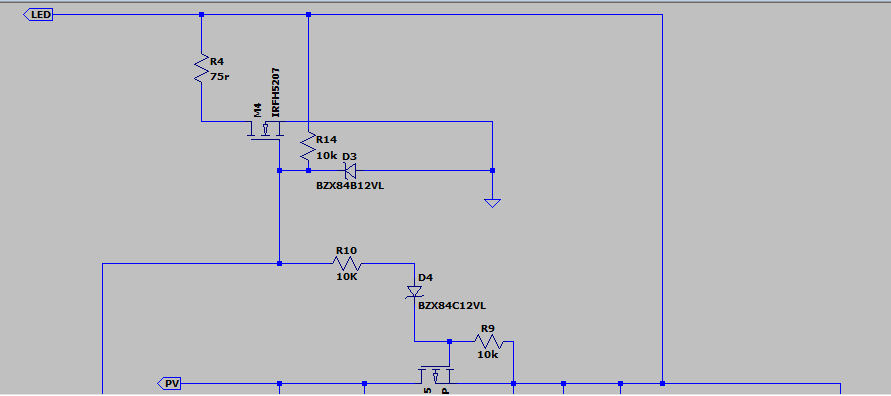
When boost mode is used to drive an LED, T2 should be kept OFF, so LED_EN will be at 0V, in this way gate of Q6 will be pulled high through R20 an it will switch ON, finally the LED(-) will get it’s GND.
D6 anode will not be at potential 0, it will be in series with D7 so the total bias voltage will be approx 2x10V=20V so the cathode of D6, gate of Q5 will be at 20-40=-20V vs. its source. The circuit should work fine up to 40V.
We could use BZX84C12 for example and the circuit should operate safe in 34-44V range in boost mode.
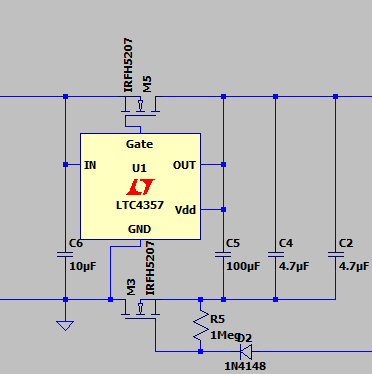
Another option could be to add a diode controller like LTC4357 for Q5, this will help to get rid of the above described limitations.
Great that you received it 
You are right, in boost mode it should be fine. However, in buck mode (LED_EN at 3.3V) you would still have a too high voltage difference at Q5 gate as soon as the solar voltage is above around 30V. Not much difference in case of 12V Zener. Maybe this issue could be solved with a resistor placed in series with the Zener diode… but didn’t check in detail.
Yes, ideal diode controller is also an option. But not the cheapest, I guess.
Right. A resistor around 10k should be ok to protect the gate in case of PV voltage up to around 50V
0r @ PV50V
Great, yes, that seems to do the trick.
Now that we sorted out some hw issues I will build a test config to give a try.
Meanwhile I also need to study the firmware more deeply.
I found that dcdc mode is defined in config.h “#define DCDC_MODE_INIT MODE_MPPT_BUCK”
I will need to be able to modify dc/dc mode during runtime (switch it to boost on evening, and back to buck in the morning) so I’m wondering if there is a safe way doing this?
The nanogrid mode also switches dynamically between boost and buck depending on the voltage at high voltage side, so that should be possible.
The difference between boost and buck mode is mainly that the control target changes. The DC/DC always tries to control the output port current/voltage setpoints while taking care that the limits at the input are not exceeded. So if you change dcdc.mode dynamically during operation it would change its control target. (in buck mode, output control target is LV side)
The safest way would be to switch off the DC/DC first (dcdc.enable = false), then change the settings of HV and LV ports and then switch on the DC/DC in the correct mode again.
Thanks Maritin, I will give a try.
I know it’s a little bit off-topic but I have trouble uploading the fw with my original ST-link V2.
Configuring upload protocol…
AVAILABLE: blackmagic, jlink, mbed, stlink
CURRENT: upload_protocol = stlink
Uploading .pio\build\mppt-1210-hus-v0.7\firmware.elf
xPack OpenOCD, 64-bit Open On-Chip Debugger 0.10.0+dev (2019-07-17-11:28)
Licensed under GNU GPL v2
For bug reports, read
http://openocd.org/doc/doxygen/bugs.html
Info : The selected transport took over low-level target control. The results might differ compared to plain JTAG/SWD
srst_only separate srst_nogate srst_open_drain connect_deassert_srst
Info : clock speed 300 kHz
Info : STLINK V2J29S7 (API v2) VID:PID 0483:3748
Info : Target voltage: 1.087328
Error: target voltage may be too low for reliable debugging
Info : stm32l0.cpu: hardware has 4 breakpoints, 2 watchpoints
Info : Listening on port 3333 for gdb connections
Info : Unable to match requested speed 300 kHz, using 240 kHz
Info : Unable to match requested speed 300 kHz, using 240 kHz
target halted due to debug-request, current mode: Thread
xPSR: 0xf1000000 pc: 0x08001a50 msp: 0x20005000
STM32L0: Enabling HSI16
Info : Unable to match requested speed 2500 kHz, using 1800 kHz
Info : Unable to match requested speed 2500 kHz, using 1800 kHz
** Programming Started **
Info : Device: STM32L0xx (Cat.5)
Info : STM32L flash has dual banks. Bank (0) size is 96kb, base address is 0x8000000
Error: jtag status contains invalid mode value - communication failure
Info : Previous state query failed, trying to reconnect
Error: error writing to flash at address 0x08000000 at offset 0x00000000
embedded:startup.tcl:449: Error: ** Programming Failed **
in procedure ‘program’
in procedure ‘program_error’ called at file “embedded:startup.tcl”, line 508
at file “embedded:startup.tcl”, line 449
*** [upload] Error 1
I will try to investigate it this evening.
I spent some time to find out why my original programmer is not working but couldn’t actually find an explanation.
For anyone facing similar problem, the only way to get it working in may case is to simply let an original tool like STM32 ST-LINK utility or STM32CubeProgrammer running in the background. No need to connect to the programmer, just simply let it running. It may be a usb power management issue or whatsoever…I may spend some more time on debugging later.
Meanwhile I also started to study the fw more deeply but is quite sophisticated so I definitely will need quite some time to understand it in all it’s aspects.
@martinjaeger, do you have some more detailed docs, flowcharts etc?
If there is someone who already knows more about the fw and willing to contribute and help me to implement my idea is welcome to this thread.
I already have working prototypes but uses different hw and architecture and I can share the logic behind it and many more details to get it running on this hw.
@martinjaeger
I was just thinking that this LED driving feature could also be implemented in your new 20A MPPT. No plans to implement such a feature in your new design?
Hi @szmolnar. Sorry for not being very responsive. I’m currently in Rwanda for a solar project and quite busy.
Yeah, the STM32L0 a bit annoying. There seems to be an issue in OpenOCD which makes flashing fail sometimes. I could not find the perfect solution yet, see also here and here. However, with the original ST software or with Segger debug probes it works fine.
It might actually be possible that the new 20A MPPT design supports your setup with LED boost converter with a few tweaks. I’ll have to double-check. And I will try to upload a first design before Christmas.
Hi Martin!
that sounds promising, I’m really curios for the first design!
If you really want to implement the LED driving feature I will prepare some notes for you with all the LED lighting features I’m already using in my other designs.
Also thanks for the OpenOCD info and have a great time in Rwanda!
As mentioned in the other thread, I uploaded the new design.
Unfortunately I think that your LED application is not yet possible, but it might be with a small modification. If we make Q8 controllable with an extra GPIO, we could connect the solar panel to the MPPT port and the LED to MPPT port positive and PWM port negative. Do you think that could work? If yes, I could make Q8 controllable for the next revision.
Hallo Martin!
If I understood you correctly your plan is to:
I had not much time but at the first look it should work.
…
it’ nice to have WiFi or BLE support by using a ESP32 but it requires quite a bit of power. Isn’t better to have a LoRa radio on borad?
Yes, you understood correctly regarding Q8 control.
The WiFi is optional if people really want it. You are right, it consumes quite a lot of energy if used all the time. But the WiFi module could also be sleeping most of the time.
LoRa is quite different from WiFi and from my point of view it is more suited for monitoring, but not that much for device control or configuration, as in the typical modes it does not listen continuously for incoming connections to save energy. But it’s also possible to add LoRa via the UEXT module.
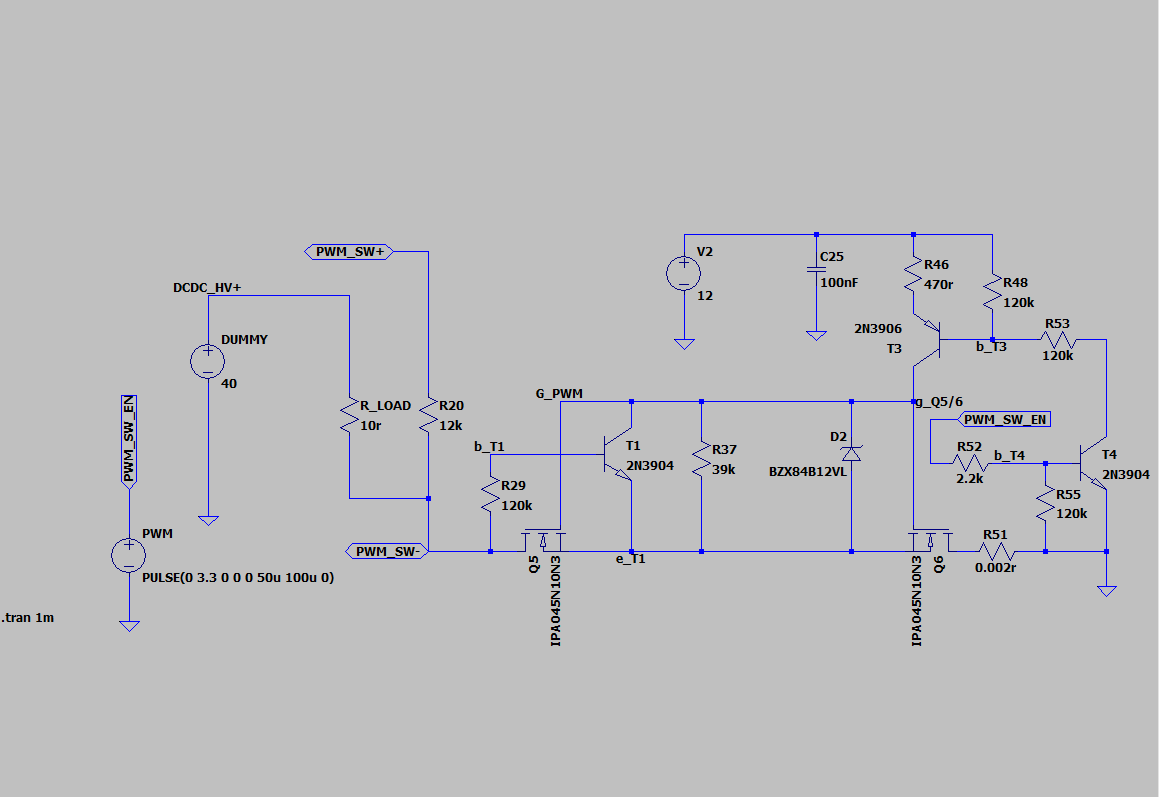
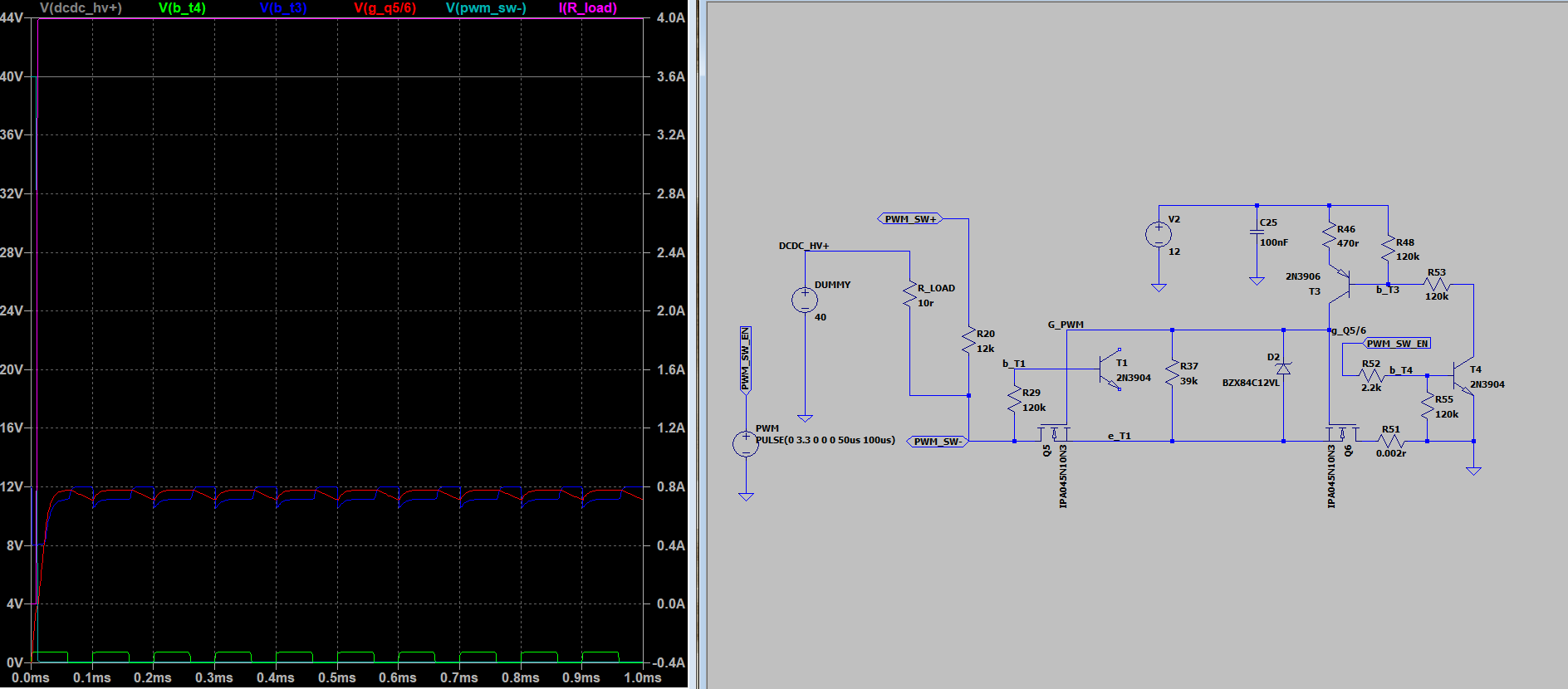
Have you simulated the PWM switch circuit already or do you have any prototype ready?
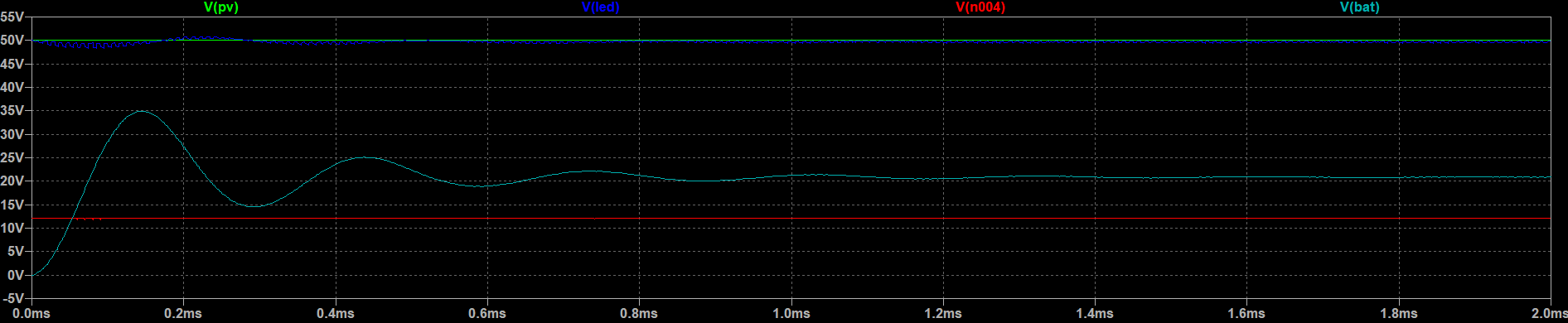
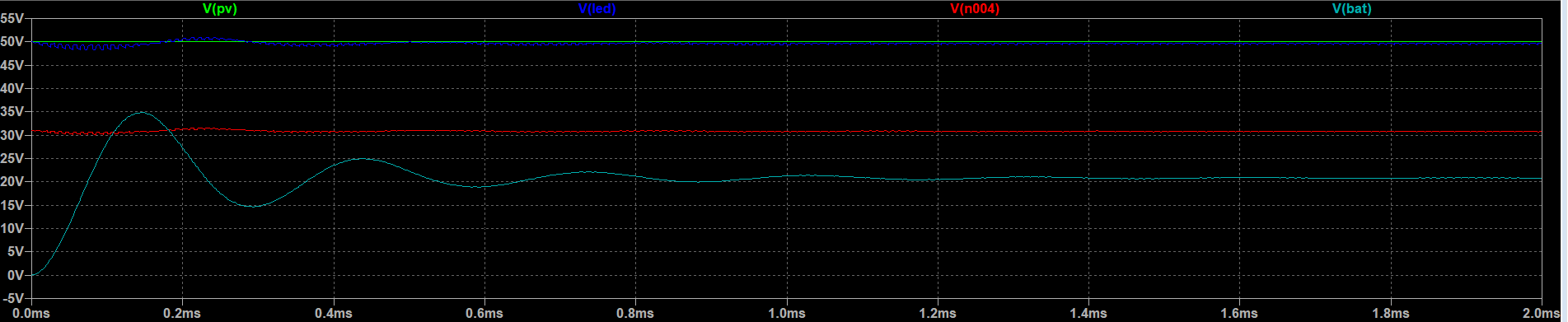
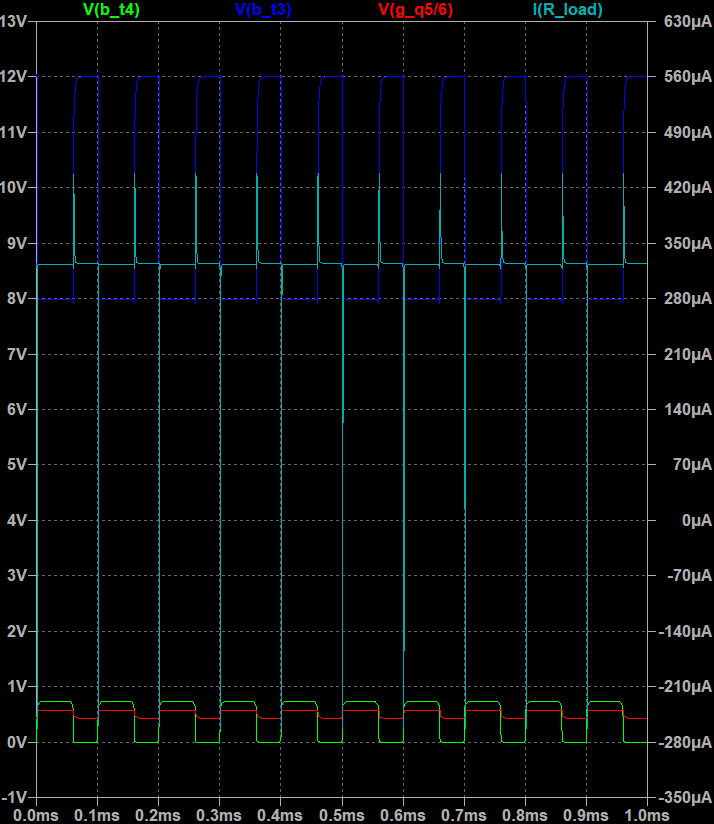
I don’t like the simulation results in LTspice.
By the way I own a SAS1000 and a IT6513C from ITECH so in case you will have ready made boards we can run some tests before summer
Finally back from Christmas + new year break
I did simulate the PWM circuit before for a solar application and it was copied from the PWM 2420 LUS, which is working fine. So far I didn’t test it in this circuit. I just got a first PCB and hope to finish soldering it today.
Looking at your LT spice schematic I realize that the LED application (I guess R_LOAD should be the LED) might need some small modifications. In contrast to the solar panel, it does not generate a voltage below GND to switch off T1. Can you take out T1 and see if it works?
Frohes Neues Jahr! 
I did that last week, switching works without T1.
Please let me know if you are ready to implement the LED feature in your FW, I can prepare some guidelines for you.
Hi, maybe i am wrong here and this topic is quite old in teh meanwhile bu ti have a question that propably best fits here. Actually more and more eKickboards are in the market. I have one wiht a 36 V/ 10 AH fixed Akku pack E-Scooter mit ABE. It is supplied with a 42 V/ 2 A power supply.
My idea is to use a single solar module that could also be used as roof for a charger station to charge it. The supplier says it has a built in BMS but needs const 42 V and externally limited 2 A/ max. 3 A to charge.The solar panel i would use is a AE_HSF_HM6-72-370W-400W – AE Solar
It has a Vmp of 41,71 V and Voc of 49,69 V.
Is it possible to modify the design for 42 V output voltage and a const current of 2 A/ 3 A?
It is not intended to charge a battery and use it to charge the eKickboard battery from external battery but due to limited capacity (10 AH) compared to peak power of the solar panel it could of course make sense to switch to a buffer battery when the eKickboard battery is charged. If this buffer battery is charged it could alos be used to charge eKickboards during night time.
This concept could also work with eBikes or other low voltage battery systems.
I´m not an electronic pro but very interested in a solution as this could probably help reduce losses in charging low voltage emobility devices.
Woudl be nice to hear from you.
Tom
Hi Tom,
don’t think that would be easily possible with the current hardware, as the solar panel voltage and the battery voltage are almost the same. So you would need a buck-boost converter topology (something like the LT8708 with 4 switches and 1 inductor).
If you use a solar panel with 18V MPP it is possible to operate the MPPT charge controller in boost mode to charge an e-bike or e-scooter battery. I’ve done that already before.
Hope that helps to answer your question.
Martin